
From Prime Residential Districts to Emerging Neighbourhoods — What Rising Rents and the Demand for Renovated Homes Reveal About Athens
By Lei Chen
Athens, Greece | Written 14 October 2026
For many years, discussions about the most desirable residential areas in Athens began with a familiar collection of names.
Kolonaki.
Kifissia.
Psychiko.
Glyfada.
Voula.
Vouliagmeni.
These districts have long represented some of the city’s most prestigious residential markets, attracting established Greek families, senior executives, international residents and investors seeking long-term property ownership.
Their appeal is understandable.
Kolonaki offers an exceptional central location and a prestigious urban environment.
The northern suburbs offer established residential neighbourhoods, greenery, international schools and access to important business districts.
The southern suburbs offer proximity to the sea, the Athenian Riviera lifestyle and an increasingly sophisticated residential market.
But the Athens rental market of 2026 tells a more complex story.
Rental growth is no longer confined to the city’s most prestigious addresses.
From Kallithea and Moschato to Gerakas, Chalandri, Nea Smyrni, Agios Dimitrios and Piraeus, rising demand for suitable residential accommodation is changing rental expectations across a much broader geographical area.
And based on my experience working in property development, renovation and rental management, one of the most interesting changes is not simply that rents are increasing.
It is that tenants are increasingly willing to distinguish between an ageing apartment and a newly renovated home.
That distinction may become one of the defining characteristics of Athens’ next residential investment cycle.
1. Kolonaki: The Traditional Benchmark of Prime Central Athens
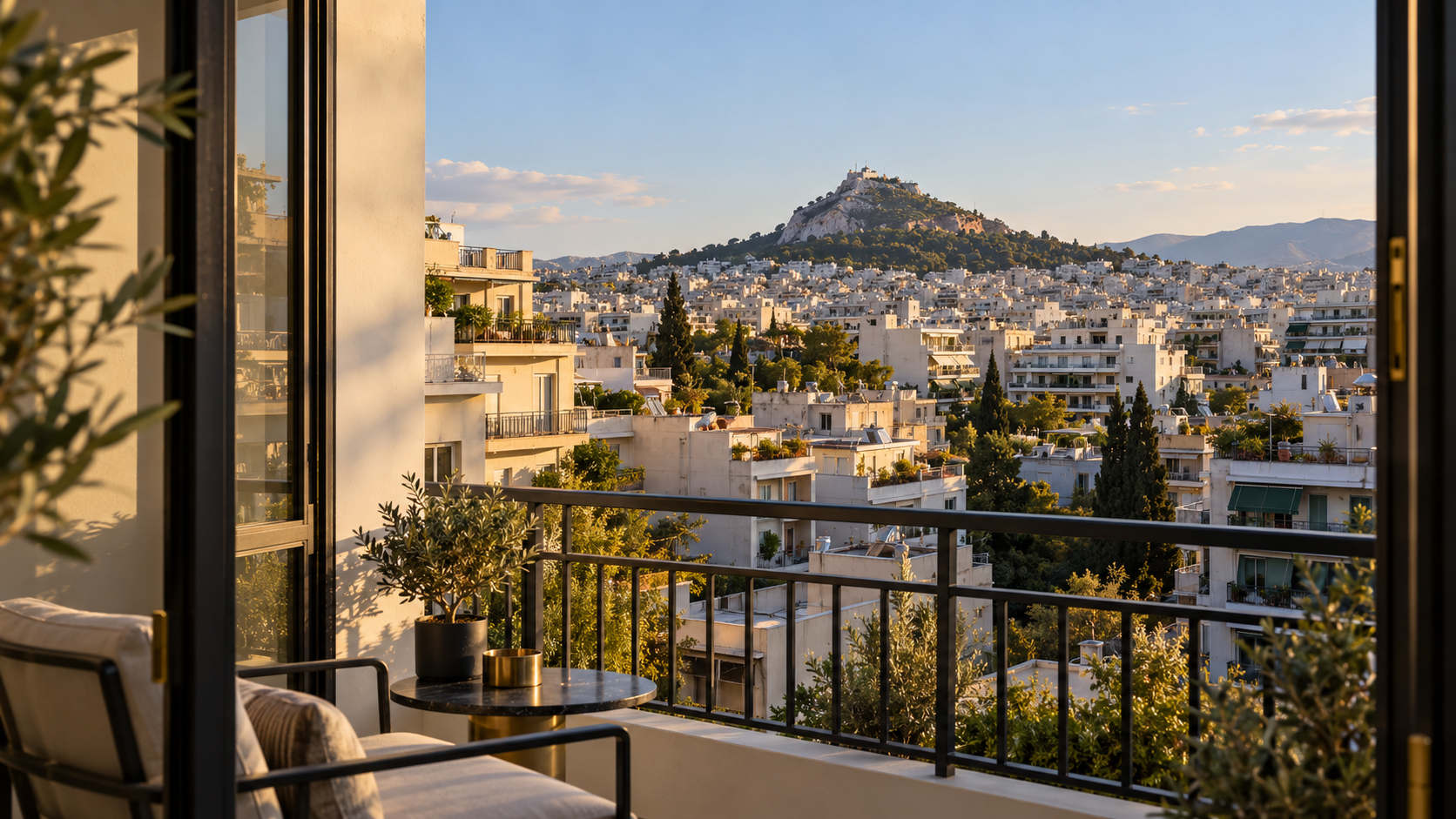
Kolonaki — Κολωνάκι — remains one of the most recognisable and prestigious neighbourhoods in central Athens.
Its value is supported by a combination of characteristics that are difficult to reproduce elsewhere.
It is close to Syntagma Square, important commercial and administrative districts, established restaurants, luxury retail, cultural institutions and the slopes of Lycabettus Hill.
Supply is also constrained by the established urban fabric.
According to Indomio’s September 2026 residential market data, the average asking rental price in Kolonaki stood at approximately €20.09 per square metre per month, an annual increase of approximately 2.8%.
The average residential asking sale price was approximately €6,404 per square metre.
These figures place Kolonaki among Athens’ premium residential markets.
But another observation is equally important.
A neighbourhood can have some of the highest rents in Athens without recording the fastest annual rental growth.
Kolonaki already commands a substantial asking-price premium. These figures alone do not establish why its annual rental growth differs from that of other districts.
Investors pay for a scarce central location, established prestige and the long-term desirability of the neighbourhood.
In other parts of Athens, however, rental growth is being driven by a different economic process.
There, the opportunity often comes not from an already expensive address, but from improving the quality of residential accommodation in areas where demand has been rising.
2. Athens Has Experienced Several Years of Significant Rental Growth
To understand today’s market, we need to look beyond a single year.
The recovery of Greek real estate following the sovereign debt crisis was initially most visible in property sales.
Residential investment returned.
Older apartments were renovated.
International buyers rediscovered Athens.
Tourism expanded, while employment and domestic economic activity gradually recovered.
The residential rental market subsequently entered its own period of adjustment.
According to an analysis of Spitogatos asking-rent data published in March 2026, rental growth was particularly strong during 2023 and 2024.
In central Athens, annual increases were approximately 8.3% in 2023 and 9.5% in 2024.
In the southern suburbs, they were approximately 8.2% and 9.5%, respectively.
Northern Athens also recorded increases, although generally at a slower pace.
Piraeus experienced particularly strong rental growth, with annual changes of approximately 10.2% in 2023 and 11.1% in 2024.
The pace moderated during 2025, although rental prices continued rising in many areas.
By February 2026, Reuters reported an estimate from E-Real Estate that average rents in Athens had increased by more than 50% between 2019 and 2024, while average Greek salaries had increased by approximately 27% over the same period.
This is an important distinction.
Rental inflation has been considerably stronger than wage growth over parts of the recovery.
It demonstrates both the economic strength of residential demand and the affordability pressure confronting Greek households.
For property owners, rising rents can improve investment income. For tenants, the same trend can create serious financial pressure.
Any responsible assessment of Athens’ property market must recognise both sides.
3. Energy Prices, Inflation and the Changing Cost of Housing
The increase in residential rents has not occurred in isolation.
Since 2022, Greece, like the rest of Europe, has experienced substantial fluctuations in energy prices, construction costs, materials, transportation and the general cost of living.
The international energy crisis affected heating, electricity and many of the inputs required to operate or renovate residential property.
More recently, renewed global energy and geopolitical uncertainty has contributed to further inflationary pressure.
According to the Hellenic Statistical Authority, Greece’s Consumer Price Index increased by 5.0% year-on-year in September 2026.
However, inflation alone does not explain rental growth.
Landlords do not automatically obtain higher rents simply because their expenses have increased.
The ability to charge more still depends on demand, available supply, tenant purchasing power and the attractiveness of the property.
The more important relationship is between rising costs and the shortage of suitable housing.
Athens has a large stock of older residential buildings.
Many apartments still require substantial renovation or energy upgrades.
New construction was limited for a long period following the Greek financial crisis.
As a result, tenants looking for modern, comfortable and energy-efficient accommodation frequently face fewer choices than the total number of existing apartments might suggest.
This creates an important distinction between the quantity of housing and the quality of housing.
Athens may have a substantial stock of residential property.
But the number of newly renovated, well-designed and energy-efficient apartments is considerably more limited.
That scarcity helps explain why renovated residential properties can command particular interest.
4. The Southern Suburbs: High Rents Supported by Lifestyle and Scarcity
The Athenian Riviera has become one of Greece’s most internationally recognised residential markets.
Glyfada, Voula, Vouliagmeni, Elliniko, Alimos and Palaio Faliro attract buyers and tenants seeking proximity to the coast, leisure facilities, commercial activity and an established international residential environment.
The rental premium is substantial.
According to XE’s third-quarter 2026 advertised rental data for residential properties of up to 80 square metres:
• Voula: approximately €20.27/m² per month, up 10.8% year-on-year.
• Glyfada: approximately €17.53/m², up 8.5%.
• Alimos: approximately €15.65/m², up 4.9%.
• Palaio Faliro: approximately €15.02/m², up 9.7%.
These figures demonstrate that the southern residential market continues to command some of the highest rental expectations in Attica.
But the variations are important.
Even within the Riviera, rental growth is not uniform.
A coastal apartment in Voula, a modern unit in Glyfada and a smaller residential property in Alimos are different products serving different tenant groups.
The strongest locations do not necessarily deliver the strongest rental yields, because their acquisition prices can also be considerably higher.
This is an important consideration for international investors.
A prestigious address can protect long-term desirability, but it does not automatically produce the highest percentage return.
5. Northern Athens: Education, Employment and Permanent Residential Demand
The northern suburbs operate according to a somewhat different economic model.
Areas such as Kifissia, Marousi, Chalandri, Psychiko and Agia Paraskevi are closely connected to long-term residential demand.
These areas attract families, professionals, executives and residents who place particular importance on schools, business accessibility and established neighbourhood infrastructure.
They are also home to a significant concentration of private and international educational institutions.
The 2026 rental data are revealing.
For properties of up to 80 square metres:
Kifissia recorded approximately €16.07/m², an annual increase of 9.5%.
Marousi reached approximately €14.86/m², up 10.6%.
Chalandri reached approximately €14.57/m², up 13.3%.
The increase in Chalandri is especially interesting.
Its asking rental level remains below that of Kifissia, yet its annual growth rate is higher.
This reflects a broader investment principle:
A property does not need to be located in the most expensive neighbourhood to experience strong rental demand.
Well-connected neighbourhoods with employment opportunities, schools, transport and a substantial permanent population can also support meaningful rental growth.
6. The Emerging Residential Markets: Where the Story Becomes More Interesting
For developers and rental investors, the most interesting developments may be occurring outside the traditionally recognised premium districts.
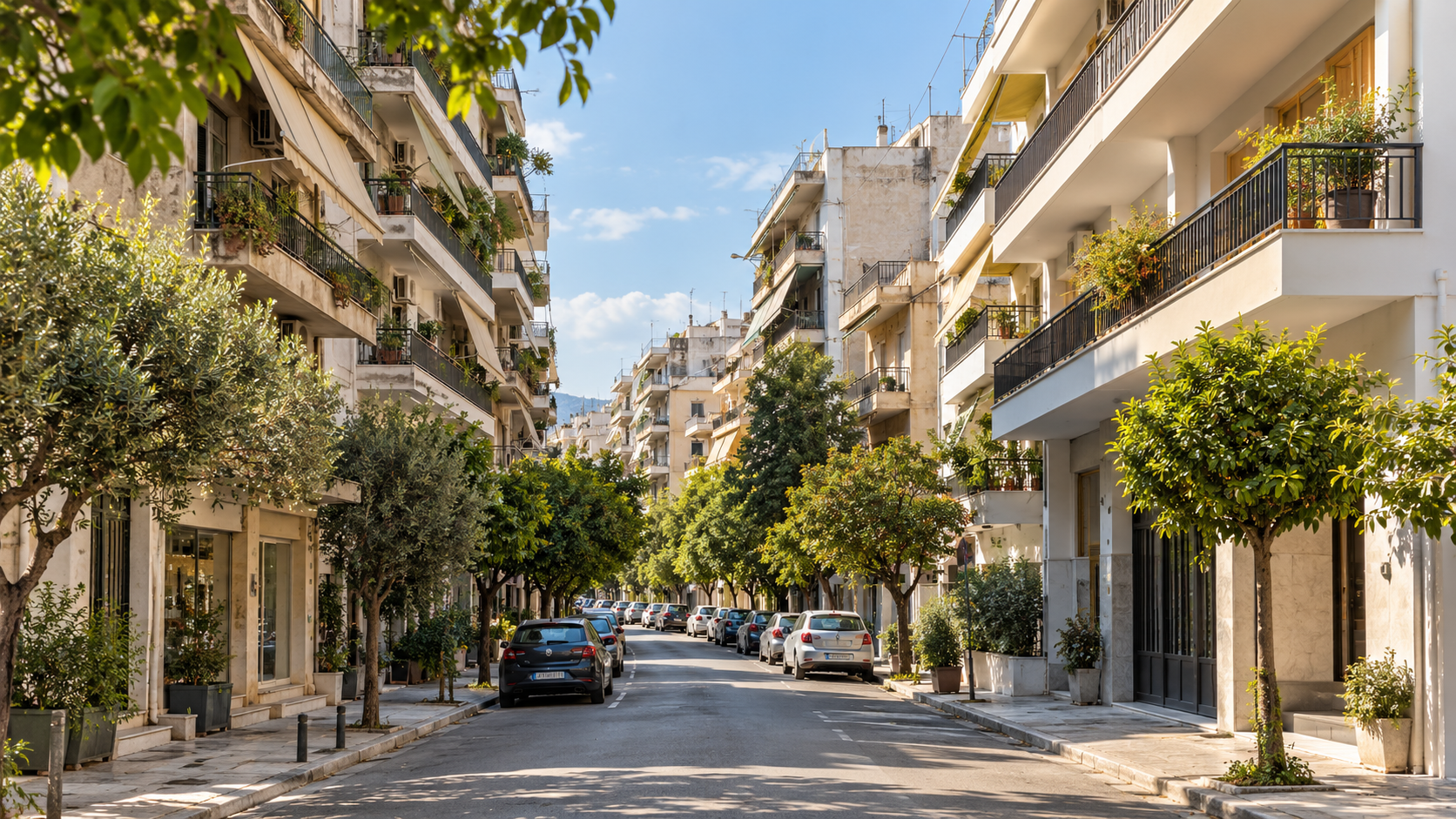
Consider Gerakas, Kallithea, Nea Smyrni, Moschato and Agios Dimitrios.
These are not identical markets.
But they share an important characteristic.
They are established places where people already live, work, travel and require permanent accommodation.
Many residents are not looking for luxury.
They are looking for a functional home.
A comfortable apartment.
A reasonable journey to work.
Access to shops, public transport and daily services.
And increasingly, a property that does not require them to deal with the maintenance problems of an old, unrenovated building.
In Gerakas, asking rents for smaller apartments increased by approximately 15.2% year-on-year in the third quarter of 2026.
Chalandri recorded 13.3%.
In Kallithea, rents rose a more moderate 4.8%, while the market continued to absorb a substantial volume of rental listings.
In Nea Smyrni, rents increased approximately 5.1%.
Agios Dimitrios recorded 6.7%.
Moschato rose by approximately 5.8%.
These differences matter.
They show that the next stage of rental growth is not simply a story about wealthy families competing for premium addresses.
It is also about ordinary residential demand across a growing metropolitan economy.
7. Athens Rental Market: District-by-District Comparison
The following table uses XE’s third-quarter 2025 and third-quarter 2026 asking-rent data.
For consistency, it focuses on residential units of up to 80 square metres, a segment especially relevant to studios, one-bedroom apartments and compact conversion projects.
| Area | Q3 2025 €/m²/month | Q3 2026 €/m²/month | Annual change |
|---|---|---|---|
| Athens — platform city category | €12.24 | €13.13 | +7.3% |
| Kallithea | €11.55 | €12.10 | +4.8% |
| Moschato | €11.98 | €12.68 | +5.8% |
| Piraeus | €11.68 | €12.37 | +5.9% |
| Nea Smyrni | €12.07 | €12.68 | +5.1% |
| Agios Dimitrios | €11.86 | €12.66 | +6.7% |
| Dafni | €11.96 | €12.72 | +6.4% |
| Alimos | €14.92 | €15.65 | +4.9% |
| Glyfada | €16.16 | €17.53 | +8.5% |
| Palaio Faliro | €13.69 | €15.02 | +9.7% |
| Voula | €18.29 | €20.27 | +10.8% |
| Chalandri | €12.86 | €14.57 | +13.3% |
| Gerakas | €10.16 | €11.70 | +15.2% |
| Kifissia | €14.68 | €16.07 | +9.5% |
| Marousi | €13.43 | €14.86 | +10.6% |
| Artemida | €9.82 | €12.02 | +22.4% |
| Metamorfosi Municipality | €10.18 | €11.14 | +9.4% |
Source: XE Property Market Trends, Q3 2025–Q3 2026. Figures represent advertised rents, not completed tenancy contracts. The data are unadjusted for changes in the composition, age or quality of listed properties.
The table contains several important lessons.
First, the most expensive districts generally remain expensive.
Second, the highest annual percentage increases are not necessarily recorded in the highest-priced districts.
Third, established residential areas outside the traditional luxury market continue to demonstrate rental demand.
And fourth, smaller apartments constitute a particularly important segment to monitor.
The unusually large increase recorded in Artemida should also be interpreted cautiously. XE reports 209 advertised properties in this size segment in Q3 2025 and 140 in Q3 2026. Changes in the listing mix can influence the comparison; these data do not establish a like-for-like increase in achieved rents.
Likewise, Metamorfosi Municipality is included as a northern market comparison; it should not be confused with Santheos’ Project Metamorfoseos, ST-023, which is located in Kallithea.
8. What Santheos’ Project Geography Reveals
Santheos’ publicly documented development portfolio provides an interesting perspective on the changing geography of Athens residential investment.
Its projects are not confined to Kolonaki, the Riviera or any one established premium residential market.
Instead, the portfolio includes properties across several distinct residential corridors.
In Kallithea, publicly listed projects include ST-001, ST-011, ST-023, ST-027, ST-028, ST-034, ST-036, ST-044 and ST-049.
In Piraeus, residential project examples include ST-005, ST-035, ST-037 and ST-046.
In Moschato, the portfolio includes ST-014 and ST-042.
In Gerakas, it includes ST-010, ST-029 and ST-047.
Other publicly documented project locations include Alimos, Glyfada, Nea Smyrni, Agios Dimitrios, Dafni, Chalandri, Artemida, Nea Filadelfeia, Mati and several central Athens locations.
This geographical distribution is important because the rental markets of these areas behave differently.
A property in Glyfada may be evaluated partly through coastal scarcity and lifestyle.
A renovated apartment in Kallithea may appeal to tenants seeking accessibility between central Athens and the southern suburbs.
A property in Gerakas may serve demand associated with established northeastern residential communities.
A smaller apartment in Piraeus may appeal to people whose work and daily lives are connected to the port and surrounding metropolitan economy.
In each case, the rental proposition should reflect the actual tenant base.
Good property development begins by understanding who will live in the finished building.
It should not begin with the assumption that every district will attract the same tenant or command the same rent.
9. Why Renovated Apartments Can Outperform Their Immediate Surroundings
This brings me to an observation from our own development and property-management experience.
When preparing rental projections, developers typically work with conservative assumptions based on available market evidence.
We examine comparable properties.
We consider the location, apartment size, expected tenant profile and prevailing rental prices.
We also take account of the fact that many buildings in Athens have been occupied for several decades.
Yet when certain newly renovated properties reach the rental market, we sometimes discover that actual tenant interest is stronger than originally anticipated.
In selected cases, potential tenants have demonstrated a willingness to pay somewhat more than our initial rental assumptions.
I believe this reflects a change in tenant preferences.
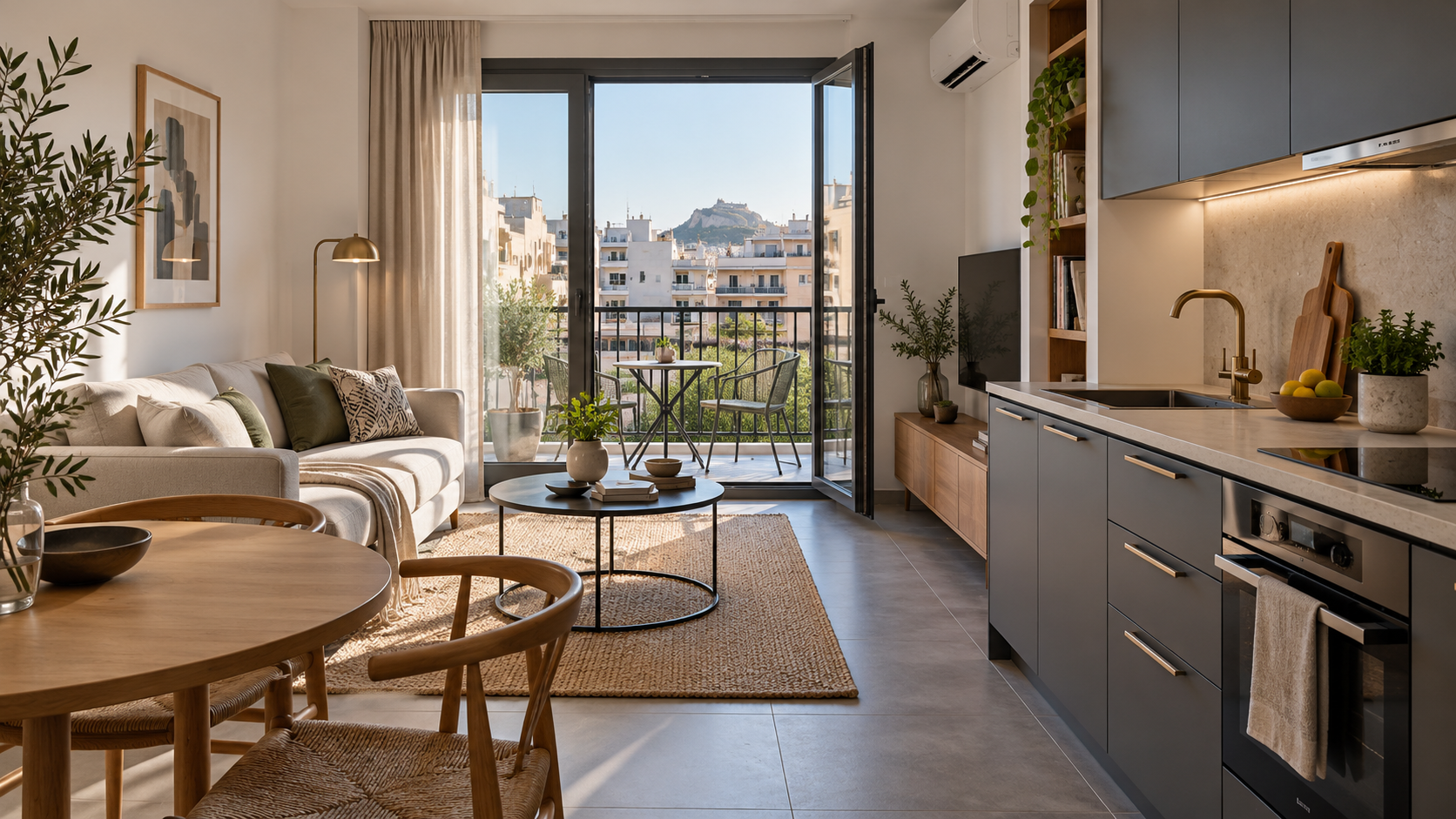
A tenant is not simply renting 45 or 55 square metres.
The tenant is evaluating the living experience.
Is the electrical system modern?
Is the bathroom new?
Is the kitchen practical?
Are the windows and insulation suitable?
Is the heating and cooling system efficient?
Is the building entrance maintained?
Is the apartment furnished appropriately?
Does the property feel clean, safe and ready to occupy?
These considerations can make a substantial difference.
A fully renovated apartment with modern facilities may compete not only against other properties in the same building, but against a much wider market of tenants seeking better accommodation.
That is where development quality becomes an economic advantage.
However, our property-management observations should not be confused with a published statistical study of achieved rents. A measurable renovation premium would require matched comparisons controlling for location, size, furnishing, lease terms and property condition.
10. The Renovation Premium Is Different From Market Inflation
This distinction deserves particular attention.
There are two separate forces operating in Athens.
The first is general market rental inflation.
This occurs when the overall relationship between housing demand and supply supports higher rents.
The second is property-specific improvement.
This occurs when a developer transforms an older or underutilised property into a residential product that tenants value more highly.
These two forces may operate together.
Imagine two apartments on the same street.
Both are approximately 50 square metres.
Both have comparable access to transport and services.
But one is an ageing apartment with an outdated kitchen, old bathroom, inefficient windows and limited modern facilities.
The other has been comprehensively renovated with modern installations, improved insulation and a functional layout.
A tenant may reasonably assign a higher rental value to the second apartment.
That difference is not simply inflation.
It is the economic value of improving the asset.
And for developers, this is particularly important.
Rental value can increase not only because a neighbourhood becomes more expensive, but because the property itself becomes more desirable.
11. The Commercial-to-Residential Conversion Opportunity
The current €250,000 Golden Visa commercial-to-residential conversion framework introduces another dimension to this discussion.
Under the applicable legal conditions, qualifying non-residential properties can be converted into residential use and become eligible within the specific investment category. The official procedure requires a minimum acquisition value of €250,000 for a single property and completion of the qualifying change of use before the residence-permit application. Eligibility must be checked for the specific property and transaction.
From a development perspective, this makes it possible to bring underutilised commercial buildings into the residential market.
The economic transformation can be substantial.
Former offices can become compact apartments.
Obsolete commercial spaces can be redesigned for contemporary residential needs.
Buildings with outdated interiors and technical systems can be modernised.
The process creates construction activity and can contribute additional residential supply to established neighbourhoods.
One Santheos example is Project Line, ST-044, in Kallithea, which is publicly described as a development of 20 apartments measuring approximately 48–56 square metres.
This type of residential product illustrates the growing importance of efficient apartment layouts.
For tenants, a well-designed 50-square-metre apartment can be more useful than a larger but poorly maintained property.
For investors, the important question becomes whether the development cost and acquisition price are justified by the rental income that the completed property can realistically achieve.
The Golden Visa can be an additional investment consideration.
But it should not replace a fundamental analysis of the asset.
12. More Rental Demand Does Not Mean Every Property Will Succeed
The strength of the rental market should not encourage unrealistic assumptions.
It would be incorrect to claim that an apartment in Athens can never remain vacant.
Vacancy depends on pricing, property condition, location, tenant preferences and management quality.
It would also be incorrect to assume that today’s rental growth rates will continue indefinitely.
In several parts of Athens, the rate of increase has already moderated from the exceptionally strong years of 2023 and 2024.
Furthermore, rising rents are creating significant affordability challenges.
If rental prices increase faster than household income for long periods, the market may eventually encounter resistance.
Some tenants will move to smaller properties.
Others will move farther from expensive neighbourhoods.
Households may share accommodation or delay moving.
And additional residential supply may gradually reduce pressure in particular segments.
Therefore, the strongest investment proposition is not that rents will always rise.
It is that well-positioned, appropriately priced and professionally managed residential properties can remain competitive across different market conditions.
13. The Next Phase: A More Selective Rental Market
Looking ahead, I believe Athens’ rental market will become increasingly differentiated.
Traditional premium areas will continue to command higher prices because of location, prestige and scarcity.
But established residential districts outside those areas may offer another type of investment opportunity.
In Kallithea, Moschato, Nea Smyrni, Gerakas, Piraeus and other neighbourhoods, investors may find a different balance between acquisition costs and rental demand.
At the same time, tenants may become increasingly selective about the quality of the apartment itself.
This could benefit professionally developed residential projects that combine practical locations with modern layouts, improved energy performance and reliable management.
But the eventual performance of each asset will still depend on the purchase price and realistic achievable rent.
A prestigious neighbourhood does not automatically guarantee an attractive rental yield.
And an emerging neighbourhood does not automatically guarantee superior appreciation.
The property must be assessed on its own merits.
Conclusion: Athens Is No Longer a Rental Market Defined Only by Its Most Expensive Neighbourhoods
For decades, Kolonaki, Kifissia, Psychiko, Glyfada and Vouliagmeni represented some of the most recognisable names in Athens residential real estate.
They remain important.
But the rental market is now telling a broader story.
Growth has extended into districts where ordinary Athenians live and work.
Smaller apartments are increasingly important to the city’s residential economy.
And newly renovated properties can offer something that much of the older housing stock cannot easily provide without further investment: a modern, functional living environment.
For international investors, this changes how Athens should be evaluated.
It is no longer sufficient to ask:
“Which neighbourhood is the most expensive?”
A better question is:
“Where does strong residential demand meet a well-designed property at an appropriate acquisition price?”
From our experience developing and managing residential property in Athens, the answer is increasingly found across a much wider geography than the city’s traditional premium districts.
Kolonaki demonstrates the value of prestige.
The Riviera demonstrates the value of lifestyle and coastal scarcity.
The northern suburbs demonstrate the value of established residential infrastructure.
And areas such as Kallithea, Moschato, Gerakas and Piraeus demonstrate the importance of practical housing demand and opportunities for urban regeneration.
Each market serves a different purpose.
And each requires a different investment strategy.
Ultimately, I believe the most important distinction in Athens residential investment is no longer simply between expensive and inexpensive neighbourhoods.
It is between properties that meet contemporary residential expectations and those that do not.
The neighbourhood creates the opportunity.
The development creates the product.
And the tenant determines its rental value.
That is where the next stage of Athens’ residential investment market will be decided.
Research Sources and Methodology
1. XE Property Market Trends — Q3 2025 to Q3 2026. District-level advertised rents for residential properties of up to 80 square metres.
https://www.xe.gr/en/property/real-estate-market-trends-in-greece
2. Indomio — Kolonaki Property Market, September 2026. Average asking rental and sale prices in Kolonaki.
https://www.indomio.gr/en/agora-akiniton/attiki/kolonaki-lykavittos/kolonaki/
3. Santheos — Official Project Directory. Publicly listed project names, reference numbers and locations.
https://www.santheos.com/projects-golden-visa-greece/
4. Eleftheros Typos — Rental Market Historical Analysis, March 2026. Historical regional asking-rent changes compiled from Spitogatos and other market data.
5. Reuters — Skyrocketing Rents Threaten Greece’s Economic Rebound, 11 February 2026 (syndicated by Investing.com). Housing affordability and historical Athens rent increases.
6. Hellenic Statistical Authority — Consumer Price Index, September 2026. Official inflation data.
https://www.statistics.gr/documents/20181/f648c4f7-3aef-a9ae-54d7-2c37e4b28208
7. Bank of Greece — Financial Stability Review, October 2025. Housing supply constraints, construction activity and affordability risks.
https://www.bankofgreece.gr/Publications/FINANCIAL_STABILITY_REVIEW_OCT_2025_%CE%95%CE%9D.pdf
8. Greek National Registry of Administrative Public Services. Official €250,000 Golden Visa change-of-use investment requirements.
Methodology: The rental figures represent advertised asking prices rather than executed lease values. Kolonaki figures come from a separate Indomio series covering a different property mix and observation period, so they are not directly comparable with the XE small-apartment table. Public Santheos projects are used to establish geographical coverage, not to imply that all listed units have been completed or rented. First-hand operational observations represent professional experience rather than audited portfolio-wide statistics.