
From Geographic Advantage and Post-Pandemic Recovery to Real Estate, Tourism, Shipping, Energy and Artificial Intelligence
By Lei Chen
Athens, Greece | 21 October 2026
For much of the past two decades, Greece was discussed internationally through the language of economic crisis.
Sovereign debt. Austerity. Unemployment. Banking instability. Declining property values.
Today, the conversation is changing.
Greece is increasingly being discussed in connection with economic recovery, foreign direct investment, urban regeneration, tourism development, maritime leadership, renewable energy, digital infrastructure and artificial intelligence.
The transformation is not complete. Greece remains significantly less wealthy than many Western and Northern European economies, and serious structural challenges persist.
But that difference is precisely what makes the country’s current economic position interesting.
Greece is not growing because it has already reached the economic standards of Europe’s wealthiest countries. It is growing partly because it still has considerable room to modernise, invest and converge.
Understanding this distinction is essential to understanding the investment opportunities that may emerge over the coming decade.
In my view, Greece’s economic recovery is not the product of one successful industry or one government policy.
It reflects the convergence of several powerful forces: geography, economic recovery, accumulated investment needs, European integration, international capital, public policy and, increasingly, technological transformation.
And the most important question is no longer simply how Greece recovered.
It is how far the next stage of development can take the country.
1. Geography: Greece’s Permanent Economic Advantage
Some economic advantages can be created through policy.
Others cannot.
Geography belongs to the second category.
Greece occupies a strategically important position in southeastern Europe, at the intersection of Europe, Asia and Africa.
It connects the European mainland with the Eastern Mediterranean, the Black Sea region and important maritime routes toward the Middle East and the Suez Canal.
For centuries, this location helped shape Greece’s identity as a maritime and commercial nation.
Today, it continues to influence investment in transport, shipping, logistics, tourism, energy and telecommunications.
The Port of Piraeus, for example, is not simply an important Greek port. It operates within international shipping networks connecting Asia, the Mediterranean and European markets.
Similarly, Thessaloniki has strategic importance as a potential logistics connection between the Aegean Sea and the Balkans.
The geographic advantage is also increasingly relevant to energy.
Electricity connections between Greece and neighbouring countries, together with potential projects connecting Europe to North Africa and the Eastern Mediterranean, could strengthen Greece’s role in regional energy security.
And in the digital economy, the same geographic position makes Greece attractive for international submarine telecommunications cables and data centres serving multiple regions.
This is an important point.
Greece’s geography does not change, but the economic value of that geography can change considerably as technology and international trade evolve.
What once gave Greece an advantage primarily in shipping and tourism may increasingly support its development as a regional energy and digital infrastructure hub.
Geography alone does not guarantee prosperity. It must be supported by competitive infrastructure, reliable institutions and efficient execution.
But it provides a foundation that few countries can replicate.
2. The Post-Pandemic Recovery Was More Than a Temporary Rebound
The economic data demonstrate that Greece has experienced a substantial recovery since the pandemic.
According to Enterprise Greece and the Hellenic Statistical Authority, real GDP growth followed this trajectory:
| Year | Greek real GDP growth |
|---|---|
| 2021 | +8.7% |
| 2022 | +5.5% |
| 2023 | +2.1% |
| 2024 | +2.1% |
| 2025 | +2.1% |
The first two years reflected the reopening of the economy and recovery from the extraordinary disruption of 2020.
But the continued growth of approximately 2.1% annually between 2023 and 2025 suggests something more durable than a simple post-pandemic bounce.
Greek nominal GDP reached approximately €248.4 billion in 2025, while unemployment fell from approximately 17.3% in 2019 to 8.9% in 2025.
The European Commission’s May 2026 forecast projects Greek economic growth of 1.8% in 2026 and 1.6% in 2027.
These figures are not spectacular when compared with the fastest-growing emerging economies.
But they remain significant in the European context.
For 2026, the European Commission forecasts euro-area growth of approximately 0.9%, meaning Greece is expected to grow at roughly twice the euro-area rate.
There is another important development.
Greece regained investment-grade sovereign credit ratings from major international agencies beginning in 2023, reflecting improvements in fiscal credibility and market confidence.
The combination of economic recovery, declining unemployment, stronger public finances and renewed international confidence has changed the way Greece is perceived.
A decade ago, foreign investors frequently evaluated Greece primarily as a distressed market.
Today, an increasing number evaluate it as a recovering European economy with opportunities for long-term development.
These are fundamentally different investment environments.
3. Greece’s Economic Gap With Northern Europe Is Also Part of Its Opportunity
One of the most misunderstood aspects of Greece’s economic development is its relatively low economic starting point.
Greece is a member of the European Union, the euro area and the Schengen Area.
It operates within European legal, monetary and institutional frameworks.
Yet its level of economic output per person remains substantially below that of many other European economies.
According to Eurostat’s preliminary estimates released on 25 March 2026 for 2025, Greek GDP per capita measured in purchasing power standards stood at approximately 68% of the European Union average.
This gap reflects decades of economic difficulties, differences in productivity, investment levels, industrial structure and household income.
It should not be viewed automatically as a positive characteristic.
Lower incomes create real social challenges.
But from the perspective of long-term economic development, the gap also reveals substantial room for improvement.
Consider the differences between Greece and more mature Western and Northern European markets.
Many of those countries already possess highly developed transport systems, housing infrastructure, public services, industrial facilities and digital networks.
Greece continues to modernise significant parts of its economic infrastructure.
Residential buildings require renovation and energy upgrades.
Commercial buildings need repositioning.
Transport networks require investment.
Hospitality facilities can move toward higher-value international standards.
The healthcare and education sectors offer opportunities for modernisation.
Businesses need productivity improvements, digital systems and more efficient management.
Energy infrastructure requires expansion and modernisation.
Each of these gaps represents a problem to be solved.
But each can also create demand for investment.
Economic convergence is not simply a process of becoming wealthier. It is a process of replacing outdated capital, improving productivity and creating higher-value economic activity.
This is one reason Greece remains interesting despite several years of strong growth.
The recovery has advanced, but the modernisation process is far from complete.
4. International Capital Can Accelerate Economic Convergence
A relatively small economy can experience a substantial transformation when it gains access to larger international pools of investment capital.
This has become increasingly important for Greece.
According to Enterprise Greece, provisional net foreign direct investment inflows reached approximately €11.4 billion in 2025, compared with approximately €7 billion in 2024, using its latest revised statistical series.
Foreign investment has entered manufacturing, financial services, technology, transportation, tourism and property-related activities.
It is important not to treat every euro of foreign direct investment as the construction of a new factory or hotel. Official FDI statistics also include mergers, acquisitions, reinvested earnings and corporate financing transactions.
Nevertheless, the scale of cross-border capital activity illustrates how significantly Greece has re-entered international investment networks.
This capital can be especially influential when it finances productive assets.
A relatively small business may become more competitive after receiving international financing, technology or management expertise.
An old hotel may become a higher-value tourism asset through renovation and international brand management.
An obsolete building may be transformed into modern residential or commercial accommodation.
An energy company may expand renewable generation or grid infrastructure.
A technology company may use international capital to develop products for global markets.
The potential impact extends beyond the original investment.
Construction companies receive contracts.
Workers receive wages.
Engineers and professional advisers provide services.
Suppliers deliver materials.
New facilities create ongoing operational activity.
The government may receive additional tax and social-security revenues.
This is how foreign capital can contribute to domestic economic growth.
But the multiplier effect depends on how much real activity the investment generates, how much of the spending remains in Greece and whether the underlying project becomes economically productive.
A change of ownership alone does not necessarily create the same economic value as a new operating business or a substantial redevelopment project.
That distinction is increasingly important for Greece’s next stage of growth.
5. Real Estate: From Recovering Asset Values to Urban Regeneration
Real estate has been one of the most visible indicators of Greece’s recovery.
During the sovereign debt crisis, property values declined dramatically and construction activity contracted.
The market that international investors encountered during the early Golden Visa years was therefore very different from the one that exists today.
The subsequent recovery has been considerable.
According to the Bank of Greece, apartment prices across Greece increased by 9.1% in 2024 and 8.3% in 2025.
Growth has moderated, but prices continue to rise. According to provisional Bank of Greece data, in the second quarter of 2026 nominal apartment prices increased by approximately 5.5% nationally and 5.0% in Athens compared with the previous year.
These increases reflect investment, tourism-related demand, improving economic conditions and limited availability of high-quality housing.
But the more important long-term story may be the transformation of the physical housing stock itself.
Much of Athens was constructed decades ago.
Many residential buildings require improvements in energy efficiency, building systems, accessibility and interior design.
At the same time, obsolete commercial and office properties provide opportunities for conversion into residential use.
This creates a development model in which capital does more than purchase an existing property.
It can create a substantially different asset.
The future value of Greek real estate may increasingly be influenced not only by where a building stands, but by how effectively that building is transformed.
This is particularly relevant to the Greek Golden Visa’s commercial-to-residential conversion framework.
By preserving a qualifying €250,000 investment category for legally eligible conversions, Greek policy has created an incentive for international capital to participate in the reuse of underutilised buildings.
Such projects can generate construction activity, create additional residential accommodation and contribute to neighbourhood regeneration.
However, they must remain commercially sound investments in their own right. The availability of a residence permit does not guarantee rental income, capital appreciation or resale liquidity.
6. The Ellinikon: A Demonstration of Large-Scale Urban Transformation
Perhaps the most recognisable example of Greece’s changing development ambitions is The Ellinikon.
Located on the site of Athens’ former international airport, the project represents one of Europe’s largest urban regeneration initiatives.
The long-term redevelopment programme is widely described as involving approximately €8 billion of planned investment.
Its scope extends far beyond residential buildings.
The development combines housing, hospitality, commercial facilities, recreational areas, public spaces, infrastructure and coastal regeneration.
It is therefore not simply a property development.
It is an attempt to create a new urban district within metropolitan Athens.
According to LAMDA Development’s September 2026 financial results, cumulative cash proceeds from property sales associated with The Ellinikon had exceeded €1.8 billion by 31 August 2026.
The project has also progressed toward the delivery phase, with construction activity continuing across residential buildings and infrastructure.
International hospitality brands have become involved in the development.
Mandarin Oriental, for example, announced plans for a luxury hotel and branded residences within The Ellinikon.
The wider economic importance of such a development lies in its potential connections to numerous industries.
Construction creates demand for labour and materials.
Residential development attracts buyers.
Commercial spaces may create employment.
Hotels generate tourism-related economic activity.
Public spaces can improve the attractiveness of surrounding districts.
And major projects of this kind can influence expectations about the future of an entire metropolitan area.
Of course, planned investment should not be confused with completed investment.
The final economic impact will depend on delivery schedules, occupancy, operational performance and the ability to create lasting economic activity.
Nevertheless, The Ellinikon demonstrates something important.
Greece is attracting capital not only to recover existing assets, but also to create entirely new urban infrastructure.
7. Tourism: From Visitor Numbers to Higher Economic Value
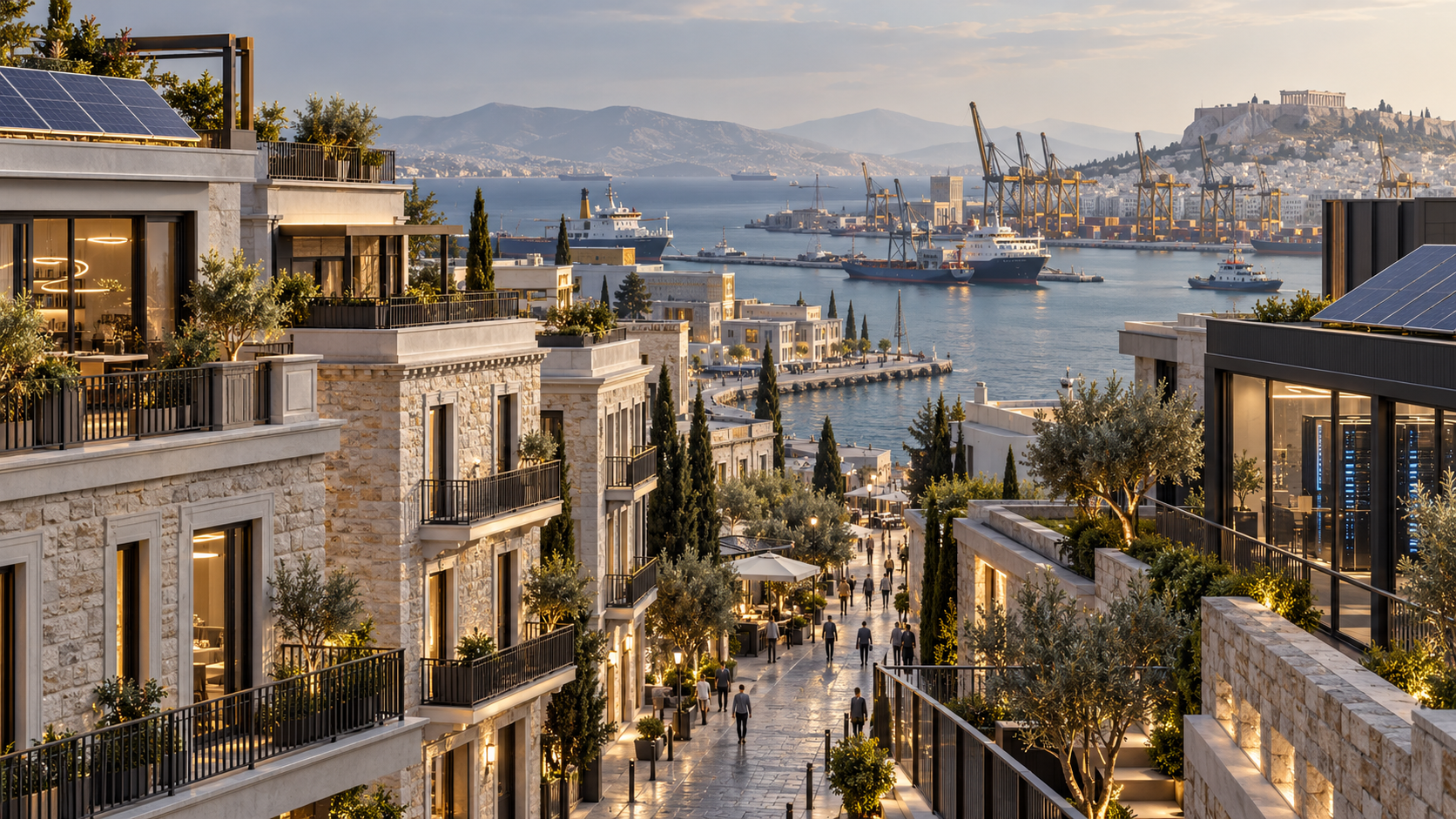
Tourism remains one of Greece’s strongest international advantages.
The country possesses a combination of cultural heritage, natural landscapes, coastline, islands, climate and historical identity that would be extremely difficult for another destination to reproduce.
But Greece’s tourism development is increasingly about more than attracting additional visitors.
It is also about increasing the value created by each visitor and improving the quality of the tourism product.
According to the Bank of Greece, international travel receipts reached approximately €23.63 billion in 2025, an increase of 9.4% compared with 2024.
Inbound traveller flows increased by 6.4%, while average expenditure per overnight stay also increased.
The momentum continued into 2026.
According to provisional Bank of Greece data, during the first seven months of the year, travel receipts reached approximately €13.52 billion, up 12.0% compared with the corresponding period of 2025.
These figures demonstrate the continuing international demand for Greece.
But the next phase of growth may depend increasingly on investment in the quality and diversity of tourism infrastructure.
Luxury hotels.
Marinas.
Wellness and medical tourism.
Cultural tourism.
Conference and business tourism.
High-quality holiday residences.
Longer tourism seasons.
And destinations beyond the country’s most heavily visited islands.
International hospitality groups, institutional investors and Greek business groups are actively participating in this process.
The entrance of established international brands can raise service expectations, attract higher-spending visitors and support additional investment in the surrounding economy.
But tourism also creates obligations.
Successful development requires adequate transport, water infrastructure, environmental protection, workforce availability and housing for employees.
Greece’s long-term tourism opportunity will therefore depend not simply on attracting more people, but on generating greater economic value in a sustainable manner.
8. Shipping: A Global Industry That Greece Already Leads
While many sectors of the Greek economy remain below the development levels of their Western European counterparts, shipping is an important exception.
Greece is already a global leader.
According to the Union of Greek Shipowners’ 2025–2026 Annual Report, the Greek-owned merchant fleet comprises approximately 5,800 vessels, representing more than 19% of global carrying capacity.
Greek-controlled shipping also represents approximately 61% of the European Union-controlled merchant fleet.
These figures are extraordinary for a country of approximately 10.4 million people.
The Union of Greek Shipowners estimates that shipping contributes directly and indirectly approximately 7–8% of Greek GDP and supports around 200,000 jobs.
Its importance goes far beyond the ships themselves.
International shipping creates demand for maritime finance, insurance, legal services, technical management, logistics, ship maintenance and professional employment.
The Port of Piraeus also illustrates the country’s connection with global investment.
In August 2026, the Piraeus Port Authority marked the tenth anniversary of COSCO SHIPPING’s strategic investment, highlighting the port’s development as a major Mediterranean container and cruise hub.
Meanwhile, Thessaloniki continues to pursue improved intermodal and rail connections to Bulgaria and the broader Balkan region.
Shipping therefore provides Greece with an internationally competitive industry that can support the development of related services.
At the same time, maritime decarbonisation is creating another investment cycle involving newer ships, alternative fuels, technical upgrades and financing.
Greece already possesses an important global advantage in this sector.
The next opportunity is to ensure that more of the economic activity connected with Greek shipping generates productive value within Greece itself.
9. Energy: From Dependency to Regional Infrastructure Opportunity
Energy may become one of Greece’s most important sources of investment over the coming decade.
Historically, Greece relied heavily on imported fossil fuels and domestic lignite production.
The energy transition is changing that structure.
According to The Green Tank’s analysis of Greek electricity system data, renewable generation, excluding large hydropower, covered approximately 46.7% of national electricity demand in 2025. Large hydropower was reported separately at approximately 6%.
Solar and wind energy have become increasingly important parts of the electricity system.
But the transformation requires more than installing renewable capacity.
Electricity networks must be strengthened.
Storage capacity must increase.
Connections between countries need development.
And the power system must become more flexible and resilient.
This is creating large-scale investment opportunities.
PPC Group, one of the region’s largest energy companies, announced a €10.1 billion strategic investment plan for 2026–2028, covering renewable generation, flexible power capacity, electricity networks and associated infrastructure across Greece and southeastern Europe.
Not all of that planned investment will take place inside Greece, and the announced amount represents a forward-looking corporate programme rather than completed expenditure.
Nevertheless, it demonstrates the scale of capital being allocated to the energy transition.
Cross-border projects offer another dimension.
The proposed GREGY interconnection between Egypt and Greece envisages approximately 3,000 MW of electricity transmission capacity.
The planned Greece–Italy GRITA 2 interconnection is another major infrastructure initiative, involving an estimated investment approaching €2 billion.
These projects are at different development stages and remain subject to implementation risks.
But their strategic significance is clear.
Greece has the potential to become not merely an energy consumer, but an increasingly important part of the energy infrastructure connecting southeastern Europe with surrounding regions.
That could create a new source of investment, employment and economic activity.
At the same time, recent high energy prices show why this transition remains urgent.
Greece’s economic competitiveness will depend not only on producing more energy, but on delivering reliable and affordable energy to households and businesses.
10. Artificial Intelligence: Greece’s New Economic Frontier
On 19 October 2026, Greece reached an important technological milestone.
The national supercomputer DAEDALUS was officially inaugurated at the Lavrion Technological Cultural Park, in the presence of Prime Minister Kyriakos Mitsotakis.
According to GRNET, the system achieved a measured computing performance of 85.69 petaflops, placing it 31st in the global TOP500 supercomputing ranking published in June 2026.
It is the most powerful computing system Greece has acquired.
The project is particularly significant because Greece has not historically been regarded as one of Europe’s leading centres of advanced computing infrastructure.
DAEDALUS represents an investment in the technological capacity required for more sophisticated research, modelling and artificial intelligence applications.
Research institutions, universities, companies and public bodies are expected to gain access progressively, with user access scheduled to begin from December 2026.
But the larger opportunity extends beyond the supercomputer itself.
Greece is also participating in Europe’s AI Factory initiative through the PHAROS project.
According to the European Commission, PHAROS has a total project budget of approximately €30 million, supported by European and national funding.
The project is designed to help businesses, start-ups, researchers and public institutions access advanced AI computing capabilities.
This creates a potentially important new layer in Greece’s economic development.
For decades, the country’s international economic identity was strongly associated with tourism, shipping and real estate.
The next stage could include a much larger digital component.
Artificial intelligence applications.
Software development.
Research services.
Data processing.
Digital infrastructure.
Technology start-ups.
And high-value professional employment.
The supercomputer itself will not automatically create an artificial intelligence industry.
Its economic value will depend on whether businesses, researchers and entrepreneurs can use that computing capacity to develop commercially useful products and services.
Nevertheless, it represents a clear investment in the country’s future productive capabilities.
11. Data Centres: The Physical Infrastructure Behind the Digital Economy
The development of artificial intelligence also requires physical infrastructure.
Data centres are becoming an increasingly important part of the international digital economy.
And Greece’s strategic location is attracting interest from international operators.
In September 2024, European data-centre operator Data4 announced an investment programme exceeding €300 million for a new campus in Paiania, in the eastern part of the Athens metropolitan region.
The planned campus has been designed with potential power capacity of up to 90 MW.
The company identified Greece’s geographic position and international connectivity as key reasons for entering the market.
Digital Realty already operates major data-centre facilities in the Koropi area, supporting cloud and network connectivity.
These investments are economically important for several reasons.
Their construction involves engineering, electrical systems, cooling infrastructure, land development and specialised equipment.
Their operation requires skilled personnel and technical services.
They can support domestic and international technology companies.
And they can strengthen Greece’s connection to digital networks serving Europe and neighbouring regions.
However, data centres are also energy-intensive.
Their long-term economic benefits depend on electricity availability, grid capacity, competitive energy costs and the extent to which they support a wider domestic technology ecosystem.
A data centre alone does not transform an economy.
But a network of data centres, research institutions, computing facilities and growing technology businesses can form the infrastructure for a new economic sector.
This is precisely why developments such as DAEDALUS, PHAROS and international data-centre investment should be considered together.
They are different components of a potentially larger technological transformation.
12. European Funding and Government Policy Are Accelerating the Transition
Private investment alone does not explain the current transformation.
Public policy and European funding also play an important role.
Greece’s Recovery and Resilience Plan, supported by the European Union, has an overall value of approximately €36.61 billion, including national financing.
The plan includes approximately €18.22 billion in Recovery and Resilience Facility grants and €17.73 billion in loans.
It covers reforms and investments involving green energy, digital infrastructure, public administration, healthcare, education and business competitiveness.
According to the European Commission, approximately 38% of the plan supports climate-related objectives, while 21.4% supports digital transformation.
The Commission’s plan page sets August 2026 as the deadline for implementation of the relevant milestones and targets. By the date of this article, that deadline had passed; the programme should therefore be understood as time-limited support, rather than an open-ended source of future funding.
The significance of this programme goes beyond the money itself.
It helps direct investment toward areas that can improve the country’s productive capacity.
Better public services can reduce administrative costs.
Digital systems can improve efficiency.
Energy investment can improve long-term competitiveness.
Education and training can support higher-skilled employment.
Infrastructure can make private investment more attractive.
However, the programme has a defined implementation timetable, and its strongest investment effects cannot be assumed to continue indefinitely.
Indeed, the European Commission expects Greece’s economic growth to moderate in 2027 partly because Recovery and Resilience Facility-supported investment is winding down.
This creates an important test.
The objective must be to transform temporary investment support into lasting productivity and private-sector competitiveness.
That is what will determine whether the current recovery becomes a long-term development success.
13. The Greatest Challenge: Making Economic Growth Reach Ordinary Greek Households
Despite the progress, it would be misleading to describe Greece as an economy without serious challenges.
GDP has increased.
Employment has improved.
Foreign investment has returned.
Tourism receipts have reached record levels.
Important infrastructure projects are advancing.
But aggregate economic growth does not automatically translate into an equivalent improvement in every household’s standard of living.
This is perhaps the greatest challenge facing the Greek government.
According to Eurostat, in 2025 approximately 26.4% of Greece’s population lived in households spending more than 40% of disposable income on housing (net of housing allowances).
This remains one of the highest housing-cost burdens in the European Union.
Meanwhile, the IMF continues to identify productivity, demographics, workforce participation and structural investment weaknesses as important constraints on Greek economic growth.
These issues are closely connected.
If property values and rental costs increase faster than household incomes, the benefits of economic recovery become uneven.
If tourism expands without corresponding investment in workforce housing and infrastructure, the sector can create additional social pressure.
If technology investment produces high-value jobs but the education and training system cannot supply the required skills, the broader economy may not fully benefit.
And if economic development remains concentrated in Athens and a few successful tourist destinations, regional inequality may persist.
The solution cannot come from one annual budget or one political announcement.
It requires a longer process.
Higher labour productivity.
Better wages supported by stronger businesses.
Investment in education and professional skills.
More efficient public administration.
Improved healthcare.
Better transport networks.
Additional housing supply.
And more opportunities outside the capital.
The central challenge is no longer simply how to make the Greek economy larger. It is how to make the benefits of growth more widely shared.
If Greece succeeds, the result could be more important than any single year of GDP expansion.
The country could move from economic recovery toward a more balanced and higher-income development model.
14. Why the Next Several Years Still Matter for Investors
From an investment perspective, Greece now occupies an interesting position.
The country is no longer a distressed market of the kind investors encountered during the sovereign debt crisis.
Asset values have recovered considerably.
International competition has increased.
And some prime real-estate locations have already experienced substantial price appreciation.
Nevertheless, several major investment processes are still ongoing.
The Ellinikon is not yet fully completed.
Energy infrastructure continues to expand.
International hospitality investment remains active.
Digital infrastructure is developing.
DAEDALUS has been inaugurated, with user access planned from December 2026 following testing.
Public and private investment continues to modernise the economy.
The existence of these projects does not guarantee that every early investor will achieve an attractive financial return.
Investment performance still depends on acquisition cost, project execution, operating income, financing conditions, taxation and eventual exit value.
Some opportunities may already be fully priced.
Others may be affected by delays or changes in market conditions.
But the broader point remains valid.
Greece’s economic transformation is occurring over multiple investment cycles rather than through one short-lived recovery.
Investors who understand the country’s changing productive structure may therefore identify opportunities that extend well beyond traditional tourism and residential real estate.
15. The Golden Visa: Not the Destination, but the Beginning
This brings us to the Greek Golden Visa.
Since its introduction in 2013, the programme has attracted international attention and helped connect foreign investors with the Greek property market.
For many investors, the initial motivation was straightforward.
Acquire a qualifying property.
Obtain residence rights.
Create an additional base in Europe.
But the economic relationship does not necessarily end there.
Once an investor becomes familiar with Greece, other opportunities may become visible.
The investor may purchase another property outside the Golden Visa framework.
A family may explore business investment, subject to the applicable immigration, company-law and tax requirements. An investor residence permit does not itself grant access to employment.
An entrepreneur may invest in hospitality or commercial real estate.
An existing business owner may identify opportunities involving logistics, imports, exports or other services.
Some investors may eventually consider larger projects, business partnerships or investments in technology and energy.
These additional activities are not automatic outcomes of the Golden Visa, and they cannot all be counted as economic benefits generated by the programme.
Nevertheless, the Golden Visa can serve an important introductory function.
It brings international investors into contact with the Greek economy.
It encourages them to evaluate the country’s legal environment, property market, infrastructure and commercial opportunities.
And it may create relationships that lead to future economic activity.
In that sense, I increasingly see the Golden Visa as more than a residence-permit mechanism.
For some investors, it is a first step into a market they may not previously have considered.
The Golden Visa can open the door. The wider Greek economy determines whether the investor finds a reason to remain involved.
For Greece, the long-term objective should not simply be to attract more residence-permit applicants.
It should be to encourage investment that generates additional economic value.
New homes.
Renovated buildings.
Sustainable businesses.
Employment.
Tax revenue.
And productive assets that contribute to the country’s future development.
This is where investment migration can become part of a much larger economic story.
Conclusion: Greece’s Recovery Is Established. Its Transformation Is Still Underway.
Greece’s economic progress since the pandemic has been substantial.
Its geographic position continues to create international relevance.
Its tourism industry remains globally attractive.
Its shipping sector is already a world leader.
Its property market has recovered strongly.
Its energy infrastructure is entering a major transition.
And the inauguration of DAEDALUS in October 2026 provides a new symbol of the country’s ambition to participate more fully in the digital economy.
Yet Greece still has considerable ground to cover before reaching the productivity, income and infrastructure standards of Europe’s wealthiest economies.
That gap is both its challenge and part of its opportunity.
The next stage of economic development will depend on how effectively Greece transforms investment into productivity, employment, higher incomes and improved public services.
The future is not guaranteed.
External shocks, high energy prices, demographic pressure and domestic structural weaknesses can slow the process.
But the overall direction of the past several years has been clear.
Greece has moved beyond the immediate question of economic recovery.
It is now confronting the larger question of economic transformation.
For investors, understanding that difference is essential.
The most attractive opportunities may not necessarily be found where asset prices have already risen the most.
They may be found where investment can create genuinely new economic value.
And for Greece, the greatest achievement of the coming decade would not simply be higher property prices, more tourists or larger foreign investment figures.
It would be the transformation of those advantages into a stronger, more productive and more prosperous economy for the people who live there.
Greece’s recovery has already changed the country’s international image.
Its next stage of development will determine how much that recovery can change the country’s future.
Lei Chen
Athens, October 2026
Official and Institutional References
-
Enterprise Greece — Strategic Advantages and Economic Statistics. Greek GDP growth, unemployment and foreign direct investment trends, 2021–2025.
https://www.enterprisegreece.gov.gr/en/invest-in-greece/investment-helpdesk/strategic-advantages -
European Commission — Economic Forecast for Greece, May 2026. GDP growth projections, inflation, fiscal performance and structural risks.
https://economy-finance.ec.europa.eu/economic-surveillance-eu-member-states/country-pages-including-country-reports/greece/economic-forecast-greece_en -
Eurostat — GDP per Capita in Purchasing Power Standards, 2025. Greece’s relative economic position within the European Union.
https://ec.europa.eu/eurostat/web/products-eurostat-news/w/ddn-20260325-1 -
International Monetary Fund — Greece: 2026 Article IV Consultation. Macroeconomic recovery, productivity, fiscal sustainability and demographic challenges.
https://www.imf.org/en/news/articles/2026/05/27/pr26169-greece-imf-executive-board-concludes-2026-article-iv-consultation -
Bank of Greece — Residential Property Price Indices, Q2 2026. Apartment-price growth across Greece and Athens.
https://www.bankofgreece.gr/en/news-and-media/press-office/news-list/news?announcement=ac5ae869-3e94-4550-b486-ef00c4292e07 -
LAMDA Development — H1 2026 Financial Results. The Ellinikon development, construction progress and property-sales proceeds.
https://www.lamdadev.com/sites/default/files/2026-09/ld_press-release_h1-2026_en_vf_0.pdf -
Bank of Greece — Developments in the Balance of Travel Services, 2025. Tourism receipts, travel activity and regional performance.
https://www.bankofgreece.gr/en/news-and-media/press-office/news-list/news?announcement=27a32287-1c58-44e7-b900-2c92c53ffe9c -
Bank of Greece — Developments in the Balance of Travel Services, July 2026. Tourism-receipt growth during the first seven months of 2026.
https://www.bankofgreece.gr/en/news-and-media/press-office/news-list/news?announcement=a55a3d93-8e2e-42f8-a5cb-90f382b53140 -
Union of Greek Shipowners — Annual Report 2025–2026. Greek-controlled fleet, share of global shipping and economic contribution.
https://ugs.gr/en/press-releases/2026/press-release-20260526/ -
PPC Group — Strategic Investment Plan 2026–2028. Planned energy-sector investment, renewable generation and grid development.
https://www.ppcgroup.com/en/investor-relations/announcements/stock-news/stock-news-2025/ppc-group-strategic-investments-of-101-bn-over-the-2026-2028-period-targeting-ebitda-of-29-bn/ -
The Green Tank — Electricity Generation Trends, December 2025. Renewable electricity production and energy-market developments.
https://thegreentank.gr/en/2026/02/02/admie-dec25-en/ -
GRNET — Inauguration of DAEDALUS, 19 October 2026. Supercomputer performance, international ranking and research access.
https://grnet.gr/en/2026/10/19/national-supercomputer-daedalus-inaugurated/ -
European Commission — PHAROS AI Factory, CORDIS. Project scope, financing and European AI infrastructure development.
https://cordis.europa.eu/project/id/101234269 -
Data4 — €300 Million Data-Centre Investment in Greece. Planned campus in Paiania and digital connectivity strategy.
https://www.data4group.com/en/news-data4/data4-announces-major-investment-of-300-million-euros-in-greece-to-develop-new-data-center-campus/ -
European Commission — Greece’s Recovery and Resilience Plan. EU-supported reforms, grants, loans and development priorities.
https://reforms-investments.ec.europa.eu/recovery-and-resilience-facility-1/country-pages/greeces-recovery-and-resilience-plan_en -
Eurostat — Key Figures on European Living Conditions, 2026. Housing affordability, household financial pressure and inequalities.
https://ec.europa.eu/eurostat/documents/15216629/24279737/KS-01-26-036-EN-N.pdf/6546c110-cf94-2b55-e64a-39f68170325d?download=true&t=1789632187156&version=2.0 -
Greek National Registry of Administrative Public Services — Golden Visa Change-of-Use Framework. The qualifying €250,000 commercial-to-residential investment category.
https://en.mitos.gov.gr/index.php/ΔΔ:Permanent_golden_visa_(change_of_use)_–_Initial_issuance
Research Note
This article distinguishes historical economic performance from economic forecasts, announced investment programmes and projects that remain under development. Investment figures from different sectors may overlap and should not be added together to calculate an economy-wide total. Economic convergence, project implementation and capital appreciation are not guaranteed; investment opportunities must be evaluated individually.
Additional verification sources
-
ELSTAT — The Greek Economy, 2 May 2024, annual unemployment table (2019: 17.3%).
https://lms.statistics.gr/documents/20181/18272859/greek_economy_02-05-2024.pdf/cfaae316-b8d4-efa9-7237-6de43f306aa5 -
Copelouzos Group — GREGY development update, 8 September 2026 (planned 3,000 MW).
https://www.copelouzos.gr/en/news/the-landmark-gregy-project-at-the-hellenic-american-chamber-of-commerce-energy-forum-at-the-thessaloniki-international-fair/ -
Piraeus Port Authority — tenth anniversary of COSCO investment, August 2026.
https://www.olp.gr/el/nea/anakoinoseis-deltia-typou/olp-a-e-10-chronia-strategikes-ependyses-tes-cosco-shipping-mia-dekaetia-metaschematismou-gia-to-limani-tou-peiraia -
Public Debt Management Agency — sovereign credit-rating history.
https://www.pdma.gr/en/investor-relations/credit-rating -
IPTO — Annual Financial Report 2025, planned GRITA 2 investment.
https://www.admie.gr/sites/default/files/attached-files/type-file/2026/04/ANNUAL_FINANCIAL_REPORT_2025_0.pdf