

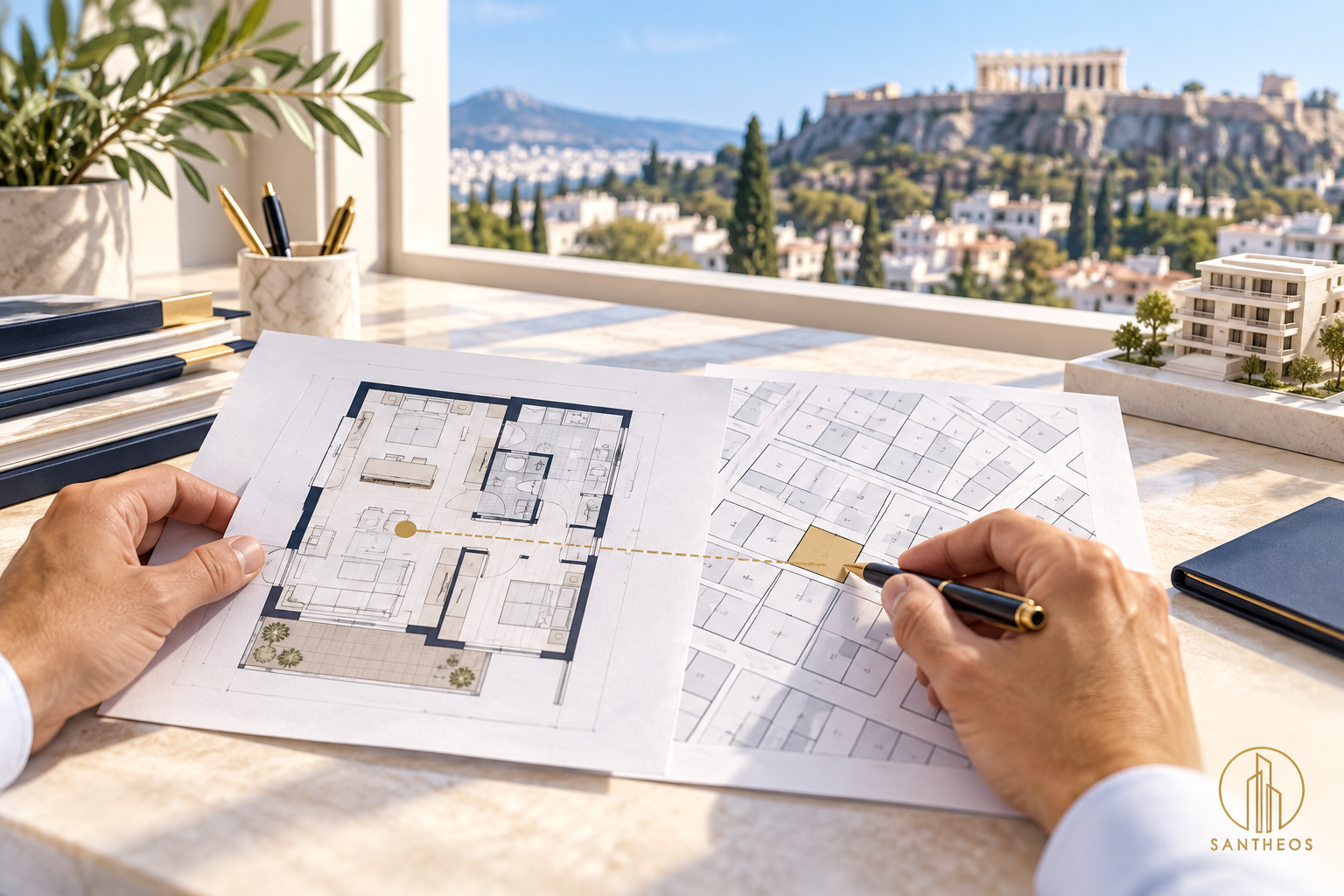
A buyer may receive a deed draft, a floor plan, a brochure and a Golden Visa document list that all appear to describe the same apartment. The file is not reconciled, however, until the identifiers and legal description point to the same right in every relevant document.
The KAEK — the identification code used by the Hellenic Cadastre — is an important anchor. It is not, by itself, a guarantee that the floor, area, ownership share, use or auxiliary spaces have been described consistently. Investors should treat it as the start of a document-matching exercise, not the end of due diligence.
What must be matched
Create one unit sheet and compare at least the following fields:
| Field | Documents to compare | Why it matters |
|---|---|---|
| Seller and ownership right | Existing title, cadastral or registry evidence, deed draft | Confirms who can transfer which right |
| KAEK or registry reference | Cadastral record, deed draft, engineer material where required | Connects the legal and technical files |
| Building, floor and unit | Horizontal-property deed, floor plan, deed draft | Prevents the wrong unit or floor from entering the contract |
| Area and ownership percentage | Title, plans, cadastral data, deed draft | Exposes material description differences |
| Existing and new use | Permit history, approved plans, change-of-use evidence, engineer report | Determines whether the claimed conversion route is supported |
| Parking and storage | Title, same-building evidence, deed draft | Tests whether auxiliary spaces are actually included and correctly identified |
The Hellenic Cadastre explains that its online services provide information about current registered rights and property entries. It also states that a KAEK is required when a cadastral certificate is requested for an area operating under the Cadastre. Those services help identify the registered property, but a buyer-appointed lawyer must interpret the legal record and any encumbrances.
The Golden Visa file adds another layer
For the EUR 250,000 qualifying change-of-use route, the current MITOS procedure requires one property and completion of the qualifying change of the main spaces to residential use before the residence-permit application. It also lists a notarial certificate containing detailed transaction information and, for specified cases, an engineer's technical report that identifies the property, including the KAEK.
This means that a correct KAEK in one document does not cure a contradictory description elsewhere. A deed that says “first floor office,” a plan that marks “second floor apartment,” and a brochure that markets “Unit B12” may refer to related commercial labels, but the file needs a documented explanation before signing or filing.
Common mismatches to stop and resolve
- The marketing unit number is used as if it were the legal horizontal-property identifier.
- The deed draft omits a storage room or parking space shown in the price schedule.
- The KAEK belongs to the wider plot or parent property while the unit-specific registration step is incomplete.
- The old title describes commercial use, but the new residential status is asserted without the relevant permit, update or revision.
- The area differs because one document uses gross commercial area and another uses the legally recorded main-space area.
- The seller named in the reservation agreement is not the registered owner or the authority of the signing company has not been evidenced.
None of these differences should be “fixed” by copying the same number into every document. The underlying legal or technical record must first be corrected, updated or properly explained by the responsible lawyer, notary or engineer.
A practical reconciliation workflow
- Freeze the exact unit. Record the project reference, marketing label, address, floor, horizontal-property description, KAEK and any auxiliary spaces.
- Obtain current title evidence. Ask the buyer-appointed lawyer which cadastral or registry certificate is appropriate and how recent it must be for the transaction.
- Match the approved technical file. The engineer should compare the unit against the relevant permit history, approved plans and change-of-use documentation.
- Mark every difference. Use a discrepancy log with an owner, required evidence and resolution date. Do not rely on an oral explanation.
- Recheck the deed draft. The final legal description, consideration and included rights should match the resolved unit sheet.
- Reconcile the immigration evidence. Before filing, compare the deed, notarial certificate, registration evidence and route-specific engineer report.
Hypothetical example
Assume a project brochure calls a unit “A-14,” while the deed draft describes horizontal property “A-13.” Both show the same street address and floor, but their ownership percentages differ. The buyer should not assume that one label is a harmless typo. The lawyer and engineer should identify the correct registered unit, establish which plan corresponds to it and obtain a corrected deed draft before funds are released.
This is a hypothetical document-control scenario, not an actual approved case.
How Santheos applies the check
For a Santheos project, the company's internal legal and risk-control team verifies the available legal and technical project file before a property-specific eligibility statement is made. The buyer's own lawyer, notary and engineer should still confirm the exact unit and the documents used for that transaction.
Related Santheos reading
- Notarial Certificate and Land Registry Evidence for a Greece Golden Visa Conversion Project
- Who Owns the Property and Who Can Sign? Seller Authority Checks
- Engineer Technical Report for an EUR 250,000 Greece Golden Visa Conversion Project
Official sources
- Hellenic Cadastre, Access to cadastral data of my properties, current online service: official service.
- Hellenic Cadastre, Electronic applications for the issuance of certificates, 26 April 2021, explaining the use of the KAEK for cadastral certificates: official announcement.
- National Registry of Administrative Public Services (MITOS), Permanent golden visa (change of use) – Initial issuance, current procedure reviewed 12 September 2026, especially the property, notarial-certificate, registration and engineer-report requirements: official procedure.
- Law 5100/2024, Government Gazette A 49/5.4.2024, Article 64 replacing Article 100 of Law 5038/2023: official Ministry-hosted PDF.
Continue your research
- Engineer Report for a Greece Golden Visa Conversion Project: What It Must Confirm
- EUR 250,000 Commercial Conversion Projects in Athens: How to Choose the Right Location
- EUR 250,000 Conversion Golden Visa Greece: Payment Trail and All-In Budget
Prepared by: Santheos Research & Project Team. Last reviewed: September 2026. General information only, not legal, tax or immigration advice. Eligibility is subject to final legal review. Review the Greece Golden Visa Encyclopedia, the official Mitos entry, or contact Santheos for a property-specific discussion.