

The Economic Multiplier of Greece’s Golden Visa — From Foreign Capital to Construction, Tax Revenue and Urban Regeneration
September 2026 | Athens, Greece
For more than a decade, the Greek Golden Visa has usually been discussed through a remarkably simple number:
€250,000.
For many years, this was the minimum real-estate investment required for a third-country national to qualify for permanent residence in Greece.
Yet €250,000 tells us surprisingly little about the programme’s true economic significance.
The real question is not simply how much an investor pays for a property.
The more important question is:
What happens to that capital after it enters the Greek economy?
Since the introduction of the Golden Visa in 2013, Greece has attracted tens of thousands of principal investors through the programme. By mid-2026, the number of active initial permanent-investor permits was approaching 25,000, while subsequent administrative data pushed the cumulative number of initial investor permits issued beyond that level.
This provides a useful perspective on scale.
If approximately 25,000 investments were valued at only the historic minimum threshold of €250,000, the resulting benchmark would already exceed:
€6.25 billion
This is not an official calculation of the actual capital invested through the programme. Investors entered at different times, under different legal frameworks and at different investment values. More recent investments may be subject to thresholds of €400,000, €500,000 or €800,000, while many transactions historically exceeded the statutory minimum.
The €6.25 billion figure should therefore be understood for what it is:
a conservative minimum-threshold benchmark illustrating the scale of capital associated with the programme.
But even this number tells only the beginning of the story.
The First Layer: The Property Transaction
Consider the traditional €250,000 investment.
Under Greece’s existing property transfer-tax framework, the standard tax is 3%, with the municipal surcharge bringing the effective burden to approximately 3.09%.
On a €250,000 transaction, this represents approximately:
€7,725 in direct property transfer taxation.
Applied purely as an illustrative calculation to €6.25 billion of benchmark transaction value, the corresponding transfer-tax amount would approach:
€193 million.
Again, this is a model rather than a historical tax-revenue figure.
Not every Golden Visa transaction was taxed identically. Different properties, transaction structures, taxable values and periods can produce different outcomes.
Nevertheless, it demonstrates an important principle.
The moment foreign capital enters the property market, part of its economic value begins to flow into public revenue.
And transfer tax is only the first layer.
The Second Layer: What Happens After the Purchase?
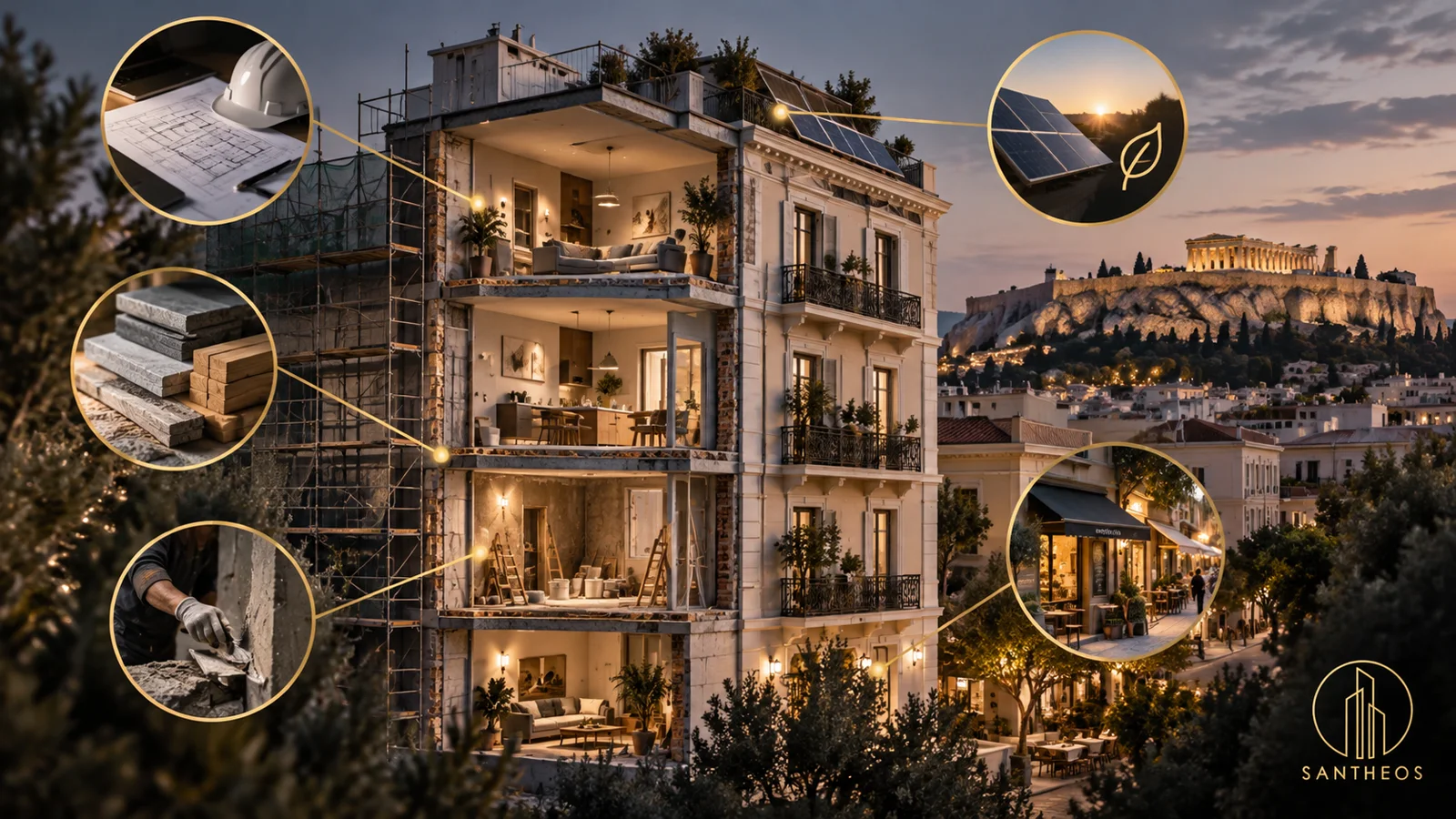
The economic impact of a property investment does not end when a contract is signed at the notary’s office.
In many cases, that is where it begins.
During the earlier years of the Golden Visa, a significant proportion of investment activity involved existing residential properties.
Many of those properties required renovation.
An international investor might purchase an older apartment and subsequently spend money on refurbishment, electrical systems, plumbing, kitchens, bathrooms, windows, heating and cooling systems, furniture and professional services.
That expenditure moves through the domestic economy.
The contractor pays employees and subcontractors.
The engineer and architect provide professional services.
Materials are purchased.
Furniture is manufactured, imported or distributed.
Transport companies move goods.
Accountants, lawyers, real-estate professionals and property managers become involved.
VAT may arise on relevant goods and services.
Companies generate taxable profits.
Employees receive wages and contribute through income taxation and social-security systems.
The property itself may subsequently generate recurring economic activity through maintenance, utilities, management and taxation.
This is why the economic contribution of the Golden Visa should never be measured solely by the purchase price of the property.
The purchase is the entry point of the capital. It is not necessarily the end of its economic journey.
From Renovating Apartments to Developing Buildings
As the Greek property market recovered, the nature of international investment also began to change.
In the early phase of the programme, the economics of many transactions could be relatively straightforward:
purchase an existing apartment, renovate it and return it to productive use.
But as demand increased and the Greek real-estate sector recovered, a more sophisticated development market emerged.
Developers began acquiring entire buildings.
Others acquired plots and developed new projects.
Obsolete commercial assets were repositioned.
Larger construction programmes required architects, engineers, contractors, project managers, building materials, energy systems, legal services and financing.
The economic footprint became substantially wider.
A €250,000 purchase of an existing apartment and a development company investing several million euros to acquire, redesign and reconstruct a building may ultimately produce the same number of qualifying investors.
But their economic footprints are entirely different.
The second model creates a much longer domestic value chain.
And this distinction is increasingly important for understanding the evolution of Greek policy.
The €250,000 Conversion Framework Changed the Economics Again
The latest structure of the Golden Visa has introduced another important transformation.
Today, conventional residential property investment is generally subject to substantially higher thresholds — €800,000 in designated high-demand markets and €400,000 in other qualifying areas.
Yet Greece preserved a specific €250,000 investment framework for qualifying properties converted from commercial or other eligible non-residential use into residential use, together with a separate category concerning qualifying listed buildings.
Economically, this is very different from simply purchasing an existing apartment.
A commercial-to-residential conversion may require:
Acquisition → architectural redesign → engineering → permits and compliance → construction → energy upgrading → materials → labour → interior completion → new residential supply.
Capital passes through a significantly longer economic chain before the final residential asset exists.
An underutilised office building can become apartments.
An obsolete commercial property can return to productive use.
A building that contributes little to its surrounding neighbourhood can attract new capital, construction activity and residents.
The result is not merely a transfer of ownership.
It can be the creation of a new economic asset.
That difference matters both economically and socially.
The Multiplier Effect
This leads to a more useful way of thinking about the Golden Visa.
Instead of asking only:
How much foreign capital entered Greece?
we should also ask:
How many times did that capital circulate through the Greek economy?
Imagine €1 million entering Greece through property investment.
Part goes to the property’s previous owner.
Another part may go into renovation or redevelopment.
Contractors receive payments.
Contractors purchase materials.
Employees receive wages.
Professional advisers receive fees.
Businesses generate margins.
Taxes and social contributions are collected at different stages.
Newly created or renovated properties then generate further activity through furnishing, utilities, maintenance, management, rental or subsequent occupation.
Economists describe this broader process through the concept of the multiplier effect.
The original investment is important.
But the economic activity generated around that investment can be equally important.
For Greece, therefore, the true economic footprint of the Golden Visa cannot be represented by one number.
It consists of layers:
foreign capital,
property transactions,
construction expenditure,
professional services,
employment,
VAT and taxation,
corporate profits,
social contributions,
urban regeneration,
and ultimately new or improved productive assets.
The 2026 Tax Reform Adds a New Dimension
The measures announced by the Greek government on 7 September 2026 add another important dimension to this discussion.
The government announced that the property transfer tax applicable to residential purchases by the relevant category of third-country nationals will increase from 3% to 15%.
Including the municipal surcharge, the effective rate would rise from approximately 3.09% to 15.45%.
Consider again a €250,000 residential purchase.
Under the existing 3.09% effective rate, the corresponding transfer-tax burden is approximately:
€7,725
At an effective 15.45%, the same theoretical taxable value would correspond to:
€38,625
That is a difference of:
€30,900 on a €250,000 transaction.
The fiscal implications are substantial.
Indeed, in its own presentation of the newly announced measures, the Greek government estimates that the higher transfer tax could generate approximately:
€100 million in additional public revenue per year from 2027 onward.
This is an exceptionally important figure.
Because it demonstrates that the economic relationship between foreign property demand and the Greek state is entering another stage.
But This Is Not Simply a Revenue-Raising Tax
It would, however, be incomplete to describe the new measure merely as an attempt to collect more money from foreign buyers.
The government’s stated rationale is broader.
According to the official announcement, increased residential demand contributes to higher housing prices and restricts permanent residents’ access to housing.
The measure therefore performs two economic functions simultaneously.
First, it increases the fiscal contribution associated with certain external residential demand.
Second, it raises the cost of competing for Greece’s existing housing stock.
That distinction is extremely important.
Even more revealing is what the announced higher tax does not target.
The government’s published framework specifically states that the measure concerns residential purchases and does not apply in the same way to professional premises, land or other real estate.
This suggests a broader policy philosophy that has become increasingly visible in recent years:
Tax competition for existing housing more heavily, while preserving space for investment that can create productive assets and potentially new housing supply.
That is not an anti-investment policy.
It is an attempt to differentiate between forms of capital.
The Numbers Are Becoming Significant
The scale of current foreign property investment makes this distinction increasingly relevant.
According to figures cited by the Greek government from the Bank of Greece, total net foreign direct investment into Greek real estate reached approximately €2.056 billion in 2025.
Of that amount, approximately:
€1.217 billion came from outside the European Union.
Using tax data, the government estimates that roughly:
€800 million concerned residential property.
These are no longer marginal flows.
Foreign property investment has become economically significant enough that Greece can increasingly ask not only how to attract it, but how to structure it.
That represents an important stage in the development of any successful investment policy.
From Revenue Generation to Social Return
There is another dimension that deserves attention.
Government revenue does not disappear when it is collected.
It becomes part of the fiscal capacity of the state.
The same 7 September economic package that contains the higher residential transfer tax also contains measures concerning housing, families, pensioners, businesses, healthcare, energy and investment.
The government estimates approximately €100 million of additional annual revenue from the higher transfer tax.
At the same time, it is expanding or introducing measures such as housing support, rent-related assistance, programmes supporting access to first homes, renovation initiatives and other social and economic measures.
One should be careful not to claim that a specific euro collected from a foreign property purchaser is legally earmarked for a specific Greek household.
Public finance does not operate that way.
But economically, the principle remains important.
International capital can expand the fiscal capacity through which government supports domestic economic and social objectives.
This is where the Golden Visa debate becomes larger than immigration.
It becomes a discussion about the relationship between foreign capital and domestic prosperity.
A Development Policy, Not Merely a Residence Programme
Seen over its full history, Greece’s Golden Visa has undergone a remarkable evolution.
In 2013, Greece needed capital.
The programme helped bring international investors into a distressed property market.
As the market recovered, those investors supported transactions and renovations.
As the development industry matured, larger projects generated construction and professional activity.
As housing pressures increased, Greece raised conventional residential investment thresholds.
As policymakers sought to create additional housing and reactivate obsolete buildings, the €250,000 conversion framework gained greater importance.
And now, as foreign residential demand remains substantial, the government is proposing a significantly higher fiscal contribution from certain third-country residential buyers.
The programme therefore cannot be understood simply as:
€250,000 → Property → Residence Permit
Its economic architecture is much broader:
Foreign Capital → Property → Development → Employment → Business Activity → Tax Revenue → Urban Regeneration → Public Fiscal Capacity
That is the more important story.
The Next Question: What Does Greece Want Foreign Capital to Create?
After more than a decade of the Golden Visa, Greece has already demonstrated that international investment can play an important role in economic recovery.
The challenge for the next decade is different.
It is no longer simply about attracting more money.
It is about increasing the quality, productivity and social return of that capital.
Can international investment create housing rather than merely compete for it?
Can it restore buildings that would otherwise remain abandoned?
Can it transform obsolete commercial stock?
Can it support construction employment?
Can it generate sustainable tax revenue?
Can it improve neighbourhoods?
Can part of the fiscal benefit ultimately support policies that improve the lives of Greek residents?
Those are the questions that will increasingly define the success of Greece’s investment framework.
And they lead to a broader conclusion.
The most successful foreign investment is not capital that merely enters a country.
It is capital that continues to work after it arrives.
For Greece, the Golden Visa has already brought billions of euros of investment-linked capital into the property economy.
Its next chapter may be more important still.
Because the objective is gradually evolving from attracting foreign wealth to transforming foreign capital into domestic economic value.
And ultimately, that is how an investment programme becomes a development policy.
Expert Perspective and Evidence Boundary
Lei Chen’s view: Greece’s Golden Visa should increasingly be assessed by the productive value created after capital enters the country—not only by the residence right attached to a qualifying investment. This is an expert interpretation of the policy direction, not a statement that every Golden Visa transaction produces the same economic or fiscal result.
Confirmed facts: The Ministry of Migration and Asylum recorded 25,679 issued initial permanent-investor permits in its July 2026 report. The Greek government’s 7 September 2026 economic-measures document describes a proposed increase in property transfer tax from 3% to 15% for specified residential purchases by third-country buyers, states 15.45% including the municipal levy, reports €1.217 billion of 2025 non-EU real-estate FDI and estimates approximately €800 million related to housing. It forecasts approximately €100 million of annual revenue from the proposed measure from 2027.
Illustrative Investor Scenario
Consider a hypothetical investor acquiring a qualifying €250,000 property and then funding design, permitting, construction, equipment and professional services. At the current effective transfer-tax rate of approximately 3.09%, the acquisition-stage tax would be about €7,725. The wider economic contribution could be higher once lawful renovation or conversion expenditure, professional fees, payroll, supplier activity and applicable VAT are included. This is an illustration only: actual costs, taxes, eligibility and economic effects depend on the asset, transaction structure, applicable law and project execution.
Investor Due-Diligence Checklist
- Confirm the precise Golden Visa investment category and threshold with an independent Greek lawyer.
- Verify whether the asset is legally residential, commercial, industrial or listed, and whether any proposed change of use is permitted.
- Check whether the announced 15% transfer-tax measure has been enacted and whether the buyer and property fall within its final scope.
- Model transfer tax, municipal levy, VAT where applicable, notarial and registration costs, professional fees and construction contingencies separately.
- For conversion or restoration projects, verify permits, completion requirements and the timing rules that apply to residence eligibility.
- Retain contracts, invoices, tax records and evidence of the source and movement of funds.
- Do not treat benchmark calculations or market-wide statistics as a guarantee of project performance, residence approval or tax outcome.
Risks, Unknowns and Limitations
The €6.25 billion and €193 million figures in this article are arithmetic benchmarks, not audited totals of Golden Visa investment or government revenue. Permit statistics do not prove that every permit corresponds to a separate €250,000 real-estate purchase, and historic investors entered under different rules and investment values. The announced higher transfer-tax measure had not yet been enacted when the cited government document was published; final legislation, commencement rules, exemptions and anti-avoidance provisions may change. Investors should obtain transaction-specific legal, tax, technical and financial advice.
Official Sources
- Greek Ministry of Migration and Asylum — Legal Migration, July 2026, Appendix B. Report month: July 2026; published August 2026; accessed 9 September 2026.
- Hellenic Government — Detailed economic measures announced at the 90th Thessaloniki International Fair. Published 7 September 2026; accessed 9 September 2026.
- Independent Authority for Public Revenue (AADE) — Real Estate Transfer Tax. Publication date not stated; accessed 9 September 2026.